

What to Expect During Oral Cancer Screening at Your Routine Dental Visit
Most people settle into the dental chair thinking about their teeth, but the few minutes spent examining your lips, tongue, and throat may be the most important part of your entire visit. Oral cancer is one of the more serious conditions a dentist screens for during a routine checkup, and the outcomes for patients who catch it early are dramatically better than those diagnosed at a later stage. Understanding what happens during a screening and why it matters can completely change the way you think about your next appointment.
At Colonia Dental Associates, preventive dentistry is built around the idea that protecting your overall health matters just as much as caring for your smile. Dr. Gurjinder Singh and Dr. Ashlee N. Apratim include oral cancer screenings as a standard part of every routine visit, so patients leave with more than clean teeth. They leave with a thorough assessment of their oral health.
What Happens During an Oral Cancer Screening
Many patients are surprised to learn that an oral cancer screening is already folded into their regular checkup. It requires no separate appointment, causes no discomfort, and takes only a few minutes. According to the Oral Cancer Foundation, close to 58,500 Americans are diagnosed with oral or oropharyngeal cancer each year, and the five-year survival rate improves significantly when the disease is caught at an early stage. That reality is exactly why we treat this screening as a non-negotiable part of every visit.
During a screening, we visually examine the entire oral cavity, including the lips, gums, tongue, the floor and roof of the mouth, and the inner cheeks. Any areas with unusual color, texture, or shape are noted carefully. We also assess the soft tissues at the back of the throat and gently palpate the jaw and neck for enlarged lymph nodes or unusual lumps. The examination is completed as a routine part of your dental exam and cleaning, with no extra steps required on your end.
What We Look for and Why It Matters
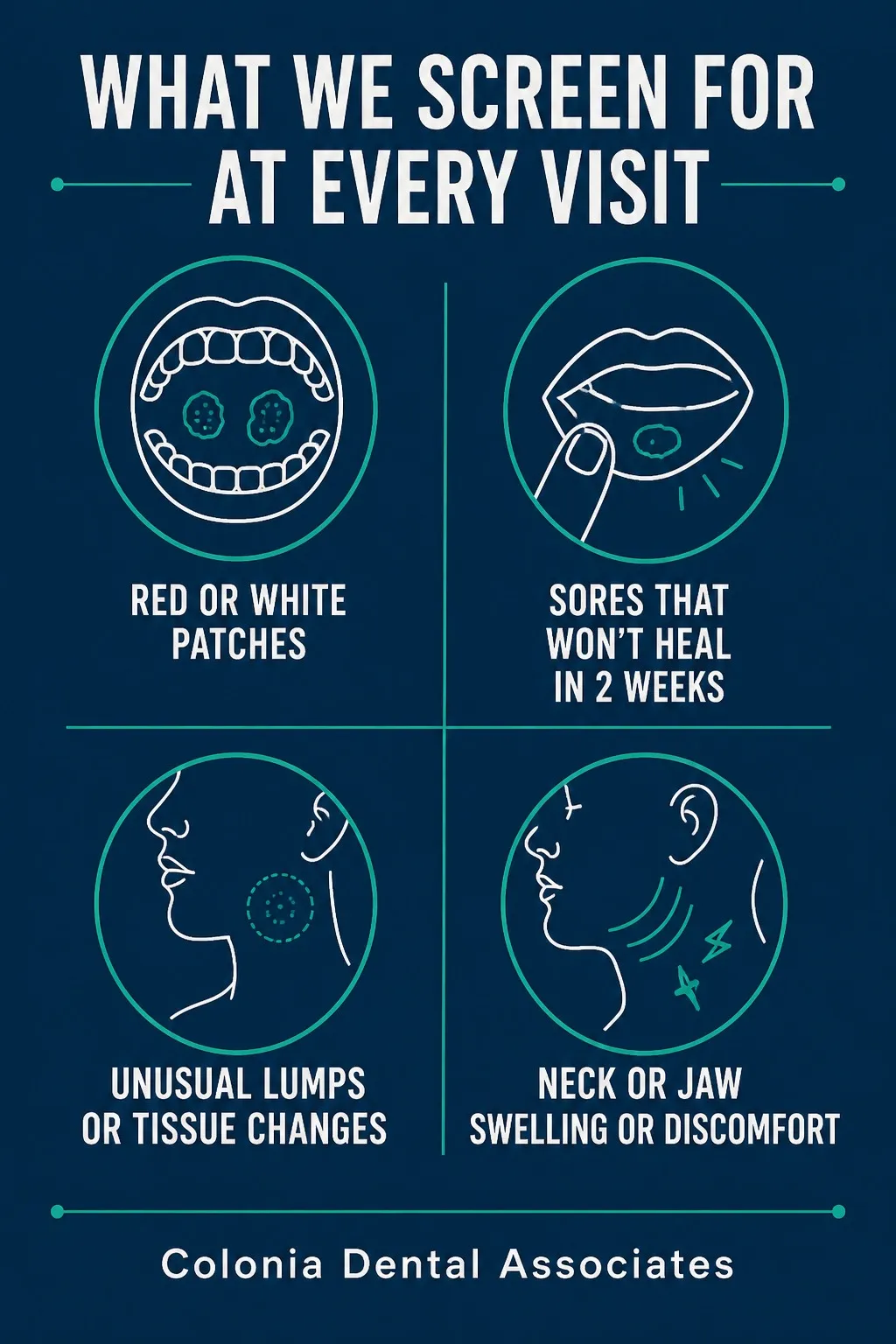
There are several specific changes we are trained to identify during a screening. Each one tells us something different about the health of your oral tissues, and none of them should be dismissed without evaluation.
The most common findings that prompt a closer look include the following:
- Red or white patches: Areas of unusual coloring inside the mouth, particularly patches that cannot be wiped away or persist beyond two weeks, are carefully evaluated and may warrant follow-up
- Persistent sores or lesions: A mouth sore that does not resolve within two to three weeks is one of the key warning signs of oral cancer. Our team is trained to identify and assess
- Unusual growths or texture changes: Thickened tissue, lumps, or any surface that feels rough or hardened to the touch may indicate a concern that requires further evaluation
- Neck or jaw abnormalities: Swelling in the jaw, limited tongue movement, or a persistent sore throat are symptoms that patients sometimes mention that factor into our overall assessment
Even when nothing unusual is found, documenting the condition of your oral tissues at each visit provides a reliable baseline to reference over time. That consistency is one of the clearest benefits of keeping up with your regular oral cancer screenings.
Who Should Be Screened and How Often
Oral cancer screenings are appropriate for all adults, and they are especially important for patients with known risk factors. Tobacco use in any form, heavy or regular alcohol consumption, HPV exposure, prolonged sun exposure, and a personal history of oral cancer all increase a patient’s baseline risk. Adults over the age of 40 are also considered a higher-risk group.
That said, routine screenings remain a valuable part of preventive care for every patient, regardless of risk factors. Annual visits that include a screening give us consistent oversight and allow us to catch changes before they progress into something more serious.
What Happens If Something Is Found
A finding during a screening does not mean a diagnosis. Depending on what we observe, we may recommend monitoring the area at a follow-up visit or refer you to an oral surgeon or specialist if a biopsy is warranted. The goal is never to cause alarm but to act thoughtfully and promptly when the situation calls for it. Early-stage oral cancer carries a significantly better prognosis than cancer identified later, and that difference starts with attentive, consistent care at every routine visit.
Schedule Your Next Visit at Colonia Dental Associates
A routine dental visit is about far more than keeping your smile looking its best. It is an opportunity for our team to monitor your overall oral health and catch potential concerns early, when they are most manageable. Dr. Singh and Dr. Apratim bring a thorough, patient-centered approach to every appointment, and oral cancer screenings are a natural part of the comprehensive care we provide at Colonia Dental Associates.
If you are overdue for a checkup or have questions about what a screening involves, we encourage you to book an appointment with our team today. Staying consistent with your preventive care is one of the most straightforward steps you can take toward long-term health.